
Asbestos Detection
Limitations Of Current Asbestos Testing
Current industry standards for measuring ACM requires a portion of the sample to be removed from its location and sent to a laboratory for analysis by Polarized Light Microscopy with Dispersion Staining.
Although this is an accredited method, there are several technical challenges to PLM including:
- Technical skills of the operator
- Only three types of asbestos can be detected
- Time required to test and validate results.
Utilising Near Infra-Red Spectroscopy (NIR) To Accurately Test Asbestos
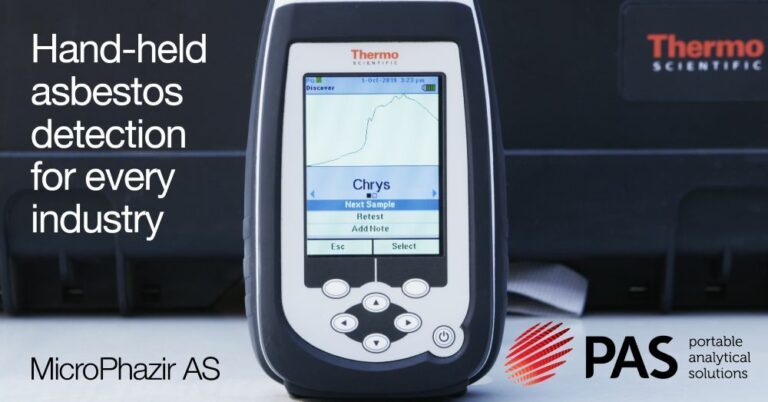
With the new ASBpro Handheld Asbestos Analyser, analysing asbestos is a non-destructive process, taking under ten seconds to return an accurate reading of possible asbestos material.
By analysing a sample with infrared spectroscopy, six different regulated asbestos minerals can be detected. More importantly, samples are not required to be removed from the site, ensuring a safer investigation.
Asbestos Minerals NIR Can Detect
NIR can detect:
- Chrysotile
- Crocidolite
- Anthophyllite
- Tremolite
- Actinolite
- Amosite
Industries That Can Benefit From Rapid Asbestos Detection
Finding asbestos at a site creates a potentially dangerous situation for workers. To learn more about the dangers of asbestos view our blog here. This will also likely lead to stoppages and complete site shutdowns, which will cost your business time and money while the area is tested and cleared.
Whilst there are numerous sectors, industries, and businesses that can benefit from having access to rapid asbestos detection technology, industries that frequently uncover asbestos-containing materials are:
- Waste Transfer & Processing
- Demolition
- Construction
- Environmental Testing
- Fire & Rescue